


My Inner Sanctuary

The wild place within us that doesn't need to be tamed.
There was a time when my mind felt like a forest I didn't know how to walk through.
Every thought wanted to take root immediately. Every question demanded an answer. A simple situation could become a maze of possibilities, consequences, interpretations and doubts.
I would think about a decision until my head hurt, and sometimes I carried thoughts that felt strangely unfamiliar—as though they had been handed down to me long before I had the chance to decide whether I believed them.
Eventually, I had to ask myself something uncomfortable:
How much of what I think is actually mine?
That question changed the way I began looking at my own mind.
The Thoughts We Inherit
I started noticing how much of us is shaped before we are even aware that we are being shaped.
Beliefs have histories. Stories have histories. Fears have histories.
Some come through family. Some through culture. Some through the expectations of society. Some seem to have been repeated for so long that they begin to feel like unquestionable truths.
I began wondering whether some of the thoughts I was treating as my own were simply old ideas that had found a place inside me.
So I started sifting.
Not rejecting everything. Not deciding that everything I had learned was wrong. Just asking:
Do I actually believe this?
Does this thought still serve me?
Is this fear mine, or did I inherit it?
What happens if I look at this situation another way?
It was slow work.
Painfully slow, sometimes.
But for the first time, I wasn't allowing every thought to immediately become a part of me.
What Nature Taught Me About Thinking
Nature became one of my teachers.
I began observing how effortlessly it allows contradiction to exist.
A forest doesn't seem troubled by the fact that one thing is growing while another is decaying. Something can be beautiful and dangerous at the same time. A tree can lose its leaves and still be alive. A flower can bloom beside something poisonous.
Nothing seems desperate to declare itself completely right or completely wrong.
It simply exists.
That gave me an idea I had never really considered before:
Perhaps my thoughts didn't all need to fight for the right to exist.
Perhaps I could let ten different perspectives on the same situation sit beside one another.
I could listen to each one.
Understand where it came from.
Notice what it was trying to protect.
And only then decide what I actually thought.
It took time to learn this. But slowly, I gained something I had never had enough of before:
Space.
And space gave me freedom.
A Garden Would Have Been Easier
When I think about my inner world now, I don't imagine a perfectly arranged garden.
A garden is beautiful. I love gardens. They appeal to my heart.
They are orderly, tended, deliberate. Someone cares for them. Someone decides what stays, what goes, where something should grow and how it should look.
But my inner world feels more like a forest.
A forest is alive in a different way.
It is buzzing with activity and yet has its own steady rhythm. It changes with the seasons and keeps going. Growth happens everywhere. Nothing needs to be constantly arranged for the sake of looking beautiful.
It can be wild.
It can be dangerous.
It requires balance.
And it lets you be.
There is something deeply comforting about a place that doesn't ask you to prune your edges before you are allowed to belong there.
The garden appeals to my heart.
The wild place within me touches my soul.
Going Into the Underworld
But a forest isn't only sunlight and flowers.
There are darker places inside it.
And there are darker places inside me.
For a long time, I wanted to move away from my anger, my rage, my sorrow, my grief, my envy and my jealousy. I thought healing meant becoming less affected by them.
Eventually, I understood something different.
Some emotions don't disappear because you tell them to.
They need to be felt.
They need to be understood.
They need to finish saying whatever they came to say.
So I began descending.
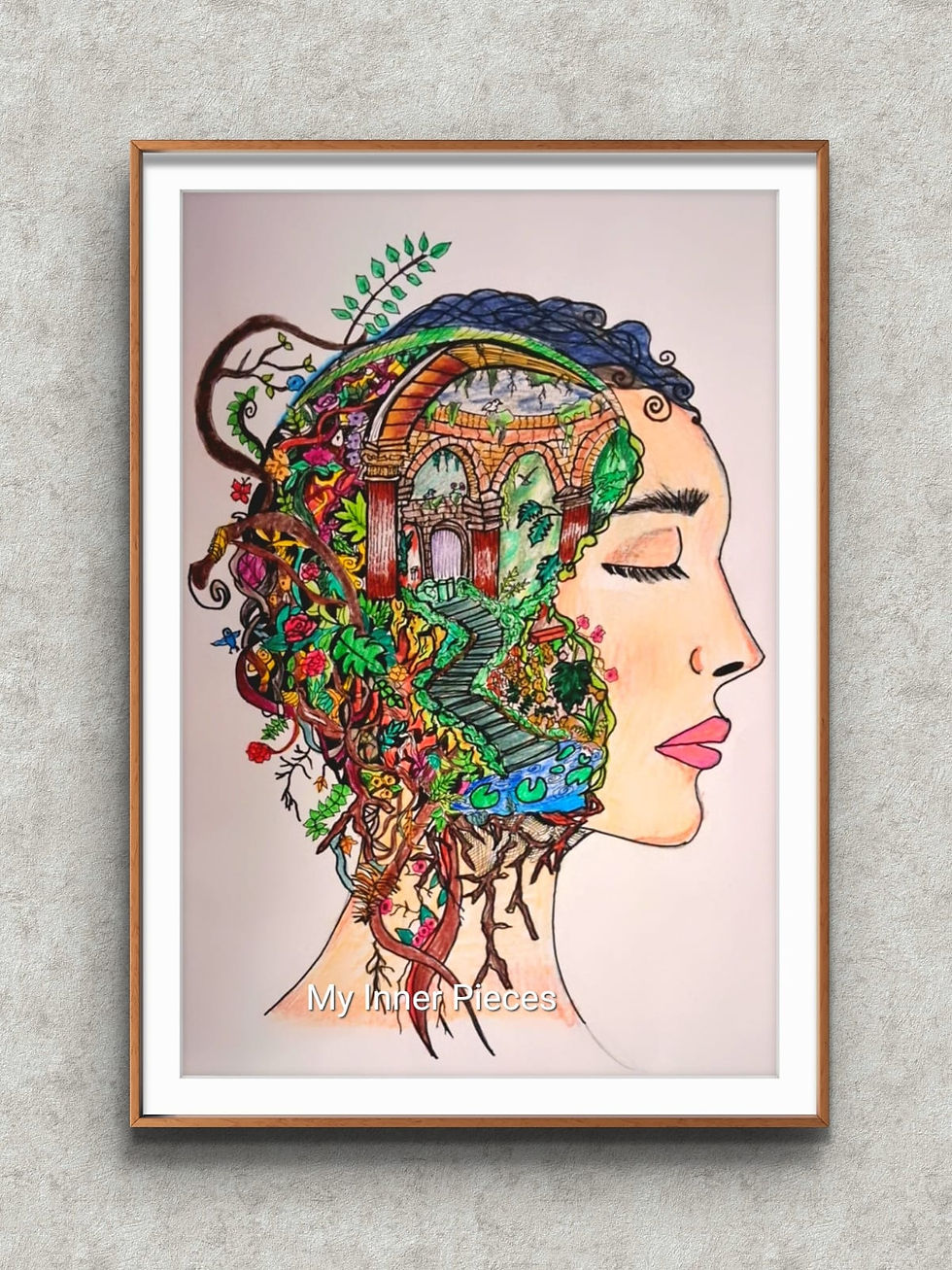
In my artwork, a staircase leads downward into the forest. To me, it is a descent into those darker parts of myself—the places I once found difficult to look at.
But the staircase doesn't lead to destruction.
It leads to a calm pool.
And that is perhaps the most important part of the sanctuary.
Because peace, I discovered, wasn't created by getting rid of my contradictions.
It came when I stopped making my contradictions fight each other.
The Women Who Live Inside Me
There are many women who live inside my inner world.
Some are archetypes.
Some are loud. Some are quiet.
Some are angry. Some are joyful.
Some are curious. Some are frightened.
Some are funny. Some are exhausted. Some are relieved.
They reveal different parts of my personality, and each has her own function.
I don't need one of them to become the permanent ruler.
They work more like a community—a group of women who know that they belong to the same place.
One might take the lead when courage is needed.
Another might tell me to be careful.
Another might want to play.
Another might need to grieve.
Another might simply want to sit quietly and watch.
They don't always agree.
But none of them needs to overpower the others unless a situation truly demands it.
That, to me, is inner peace.
Not silence. Not emptiness. Not the absence of emotion.
A peaceful inner world can be incredibly loud.
It simply doesn't have to be at war with itself.
The Architecture We Inherit
There is also architecture inside my sanctuary.
Ancient structures, pathways, walls.
They represent something different from the forest.
They remind me that some parts of who I am were built long before I arrived.
There are inherited wounds.
But there are inherited gifts too.
I don't want to tear down everything that came before me simply because some of it hurt.
I want to understand it.
To decide what deserves to continue.
To recognize what needs to end.
Perhaps becoming yourself isn't about starting from nothing.
Perhaps it is about walking through what you inherited and deciding, piece by piece, what you will carry forward.
Learning to Protect the Sanctuary
There was another kind of freedom I had to learn.
The freedom to stop making myself available to everyone.
As women, many of us are taught—directly or indirectly—to nurture. To accommodate. To understand. To absorb. To keep giving.
I began noticing how easily that can become emotional labour.
Someone can enter your life, take what they need from your energy, your attention, your understanding, your ability to listen—and leave when there is nothing more to take.
I no longer want that kind of relationship.
Not because I don't care about people.
Because I care about my peace.
I don't want to nurture people who are not my responsibility.
I don't want to hand someone access to my inner world simply because they want it.
And I don't need everyone to agree with me.
For a long time, I thought finding my voice meant fighting harder to be understood.
Now I think it can also mean turning inward and building something that doesn't require outside agreement to exist.
That is how the architecture grew.
No One Gets to Walk In Without Permission
My inner sanctuary is private.
Not secret.
Private.
There is a difference.
I can share parts of it through my art, my writing, my conversations. I can let someone see a pathway, a flower, perhaps even the pool.
But I decide who gets to walk further.
There are no automatic entrances.
Trust is the doorway.
And trust, for me, is rare.
I think about Earth when I think about this.
She has been extraordinarily giving—so giving that we have often mistaken her generosity for permission to take without limits.
I don't want my inner world to become another place someone feels entitled to extract from.
I want it to remain alive.
Wild.
Untamed.
Mine.
The Little Girl in the Forest
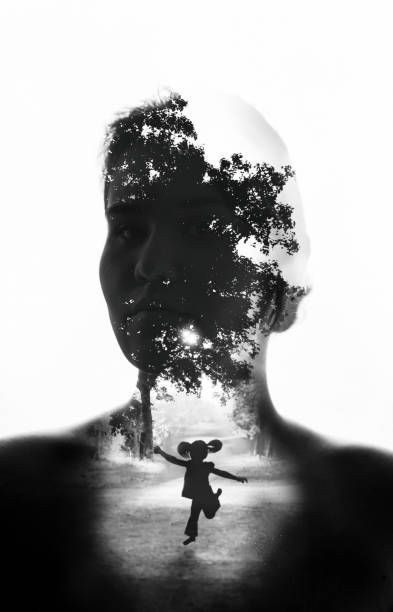
And somewhere inside this sanctuary is a little girl.
She has carried fear for a long time.
But here, she doesn't have to.
She can walk through the dense forest of complicated thoughts without worrying that something will overwhelm her.
She can explore.
She can be curious.
She can sit beside the water.
She can climb the stairs.
She can enter the old buildings.
She can do whatever she wants.
Because she knows something she didn't always know before:
Someone is taking care of her.
That someone is me.
And perhaps this is what I was really building all those years—not a perfect mind, not a life without difficult emotions, not a place where everything finally makes sense.
I was building a place where all of me could exist.
A place where anger could sit beside tenderness.
Where grief could grow beside joy.
Where inherited stories could be examined without being blindly obeyed.
Where different perspectives could coexist until something true emerged.
Where the wild could remain wild.
Where the little girl inside me could finally feel safe.
My Inner Sanctuary
This artwork is my attempt to draw that place.
The forest is my complicated mind.
The roots are everything that keeps me grounded.
The ancient architecture carries both the wounds and gifts I inherited.
The staircase is the descent into the parts of myself I once wanted to avoid.
The pool is peace.
And the woman in the centre is the part of me the world gets to see—calm on the outside, while an entire universe continues to grow within.
Perhaps we all carry such a place.
Perhaps yours doesn't look like a forest.
Maybe it's an ocean. A desert. A house. A garden. A city that exists only in your imagination.
Whatever your inner sanctuary looks like, I hope you permit yourself to discover it.
Not to make it beautiful for someone else.
Not to make it understandable.
Not to make it acceptable.
Just to know it.
Because sometimes healing isn't about making the wilderness disappear.
Sometimes it is learning how to live peacefully inside it.
And perhaps that is what a sanctuary really is:
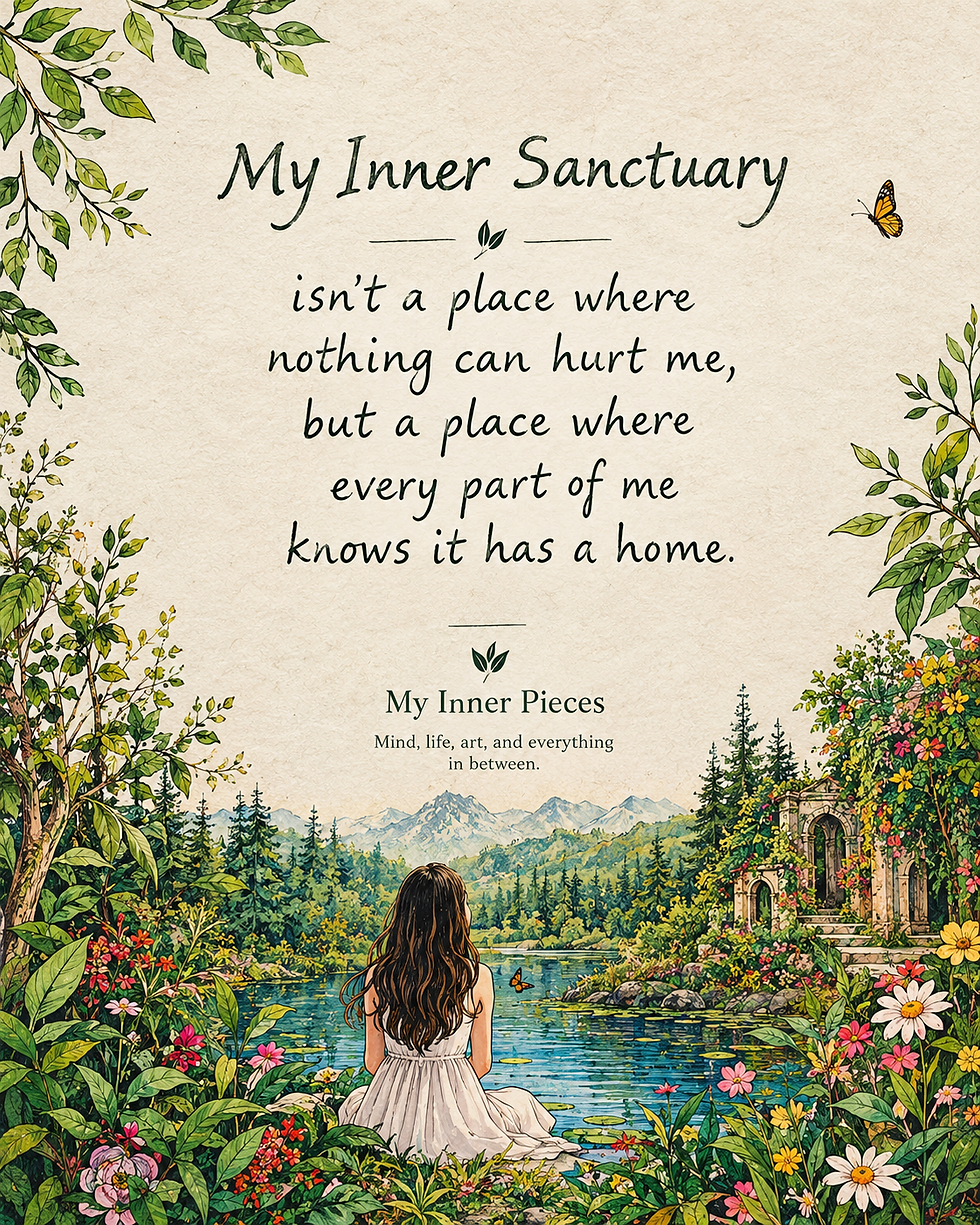
not a place where nothing can hurt you, but a place where every part of you knows it has a home.


Comments